Why Volcanoes Exist: How the Hadean Inferno Shaped Our Planet
Keywords: Hadean volcanism, komatiite, mantle plume, shield volcano, stratovolcano, plate tectonics, volcano types, magma formation, decompression melting, flux melting, hydrothermal vents, early atmosphere
Today, Earth has roughly 1,500 active volcanoes, with around 50 to 60 erupting in any given year. They line the “Ring of Fire” around the Pacific, stretch along mid-ocean ridges spanning tens of thousands of kilometres, and rise above mantle hotspots far from any plate boundary. Lava pours from fissures in the ground, ash blocks the sky, and new rock forms within hours of reaching the surface. Faced with these images, most people see destruction and disaster.
Yet from another perspective, volcanoes are a planet’s primary mechanism for releasing heat, the inevitable consequence of billions of years of accumulated thermal energy finding its way out. Every volcano on Earth, wherever it stands, points to the same underlying truth: a planet releasing itself.
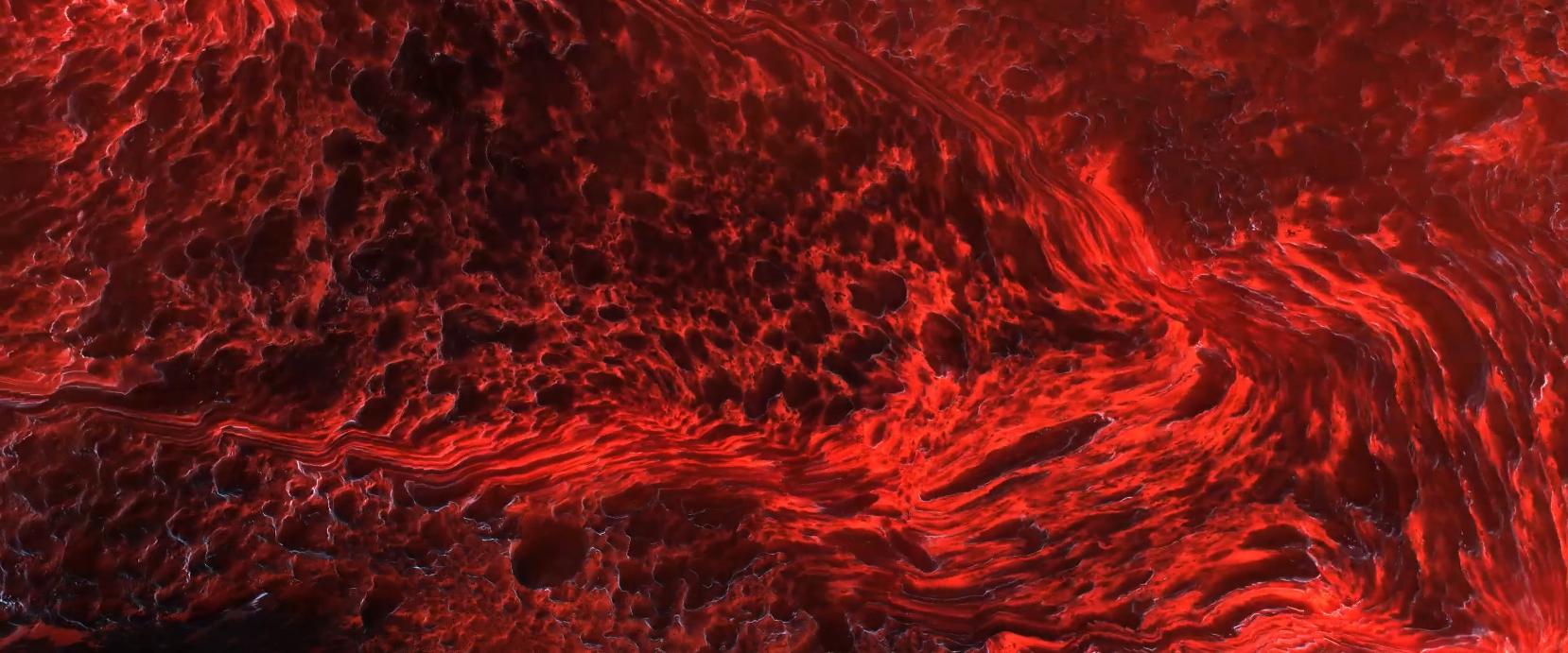
This process is spectacular enough today. But 4.6 billion years ago, in the Hadean eon, the entire surface of the Earth was a volcano. There were no continents, no soil, no shorelines, only a continuous surface of molten rock, erupting gases, and the first thin sheets of crust slowly rising from a sea of magma. Those Hadean vents did not merely destroy the surface: they built the atmosphere we breathe today, delivered the water for the first oceans, and laid the material foundations for life.
Why Volcanoes Exist
Volcanoes exist because heat trapped within the Earth must find its way to the surface. That heat escapes through three principal tectonic settings, each producing a distinct style of volcanism.
Plate tectonics and subduction zones: When a dense oceanic plate is forced beneath another plate, increasing pressure with depth causes the water and volatile compounds stored within the slab to be released.
These fluids infiltrate the overlying mantle wedge, dramatically lowering the melting point of silicate minerals and triggering partial melting even without exceptional temperatures, generating volatile-rich magma.
That magma rises to the surface and forms the world’s most active and most dangerous volcanic belt: the Ring of Fire encircling the Pacific [Lockwood et al., 2010] Volcanoes: Global Perspectives
Lockwood, J. P., Hazlett, R. W. (2010)
Wiley-Blackwell
DOI: 10.1002/9781444392876 .
Mantle hotspots and mantle plumes: Deep within the Earth, columns of anomalously hot material rise from the lower mantle, or even from the core-mantle boundary, and punch through the overlying lithosphere to create chains of hotspot volcanoes at the surface [Condie, 2001] Mantle Plumes and Their Record in Earth History
Condie, K. C. (2001)
Cambridge University Press
DOI: 10.1017/CBO9780511529733 .
Because lithospheric plates drift slowly over a stationary hotspot, the hotspot leaves a trail of progressively older volcanic islands on the moving plate; the Hawaiian Islands are the textbook example.
Hotspot magmas rise directly from the deep mantle and differ chemically from subduction-zone volcanoes, typically producing more fluid basaltic lavas.
Rifts and mid-ocean ridges: Where two plates pull apart, mantle material wells upward to fill the gap. As the overlying pressure drops, the mantle melts even without a significant rise in temperature, a process called decompression melting. The global mid-ocean ridge system, stretching tens of thousands of kilometres, is the most volcanically active zone on Earth, though most of it lies hidden beneath the deep ocean, largely unobserved. Iceland, where the ridge breaks the surface, offers a rare window into this process.
How Magma Forms
Regardless of the tectonic setting, magma generation involves one central process: triggering partial melting of solid rock. Three principal mechanisms, acting alone or in combination, transform deep solid rock into buoyant liquid magma.
Decompression melting: The melting point of rock depends not only on temperature but also on pressure. When mantle material rises through thermal convection, the weight of overlying rock decreases, reducing pressure and consequently lowering the melting point. If the temperature remains the same while the melting point drops below it, the rock begins to melt without any additional heat input. Decompression melting is the dominant mechanism at mid-ocean ridges and most mantle hotspots.
Flux melting: Certain substances, especially water and carbon dioxide, dramatically lower the melting point of silicate minerals. When a subducting oceanic plate carries seawater-infiltrated minerals and hydrated sediments into the mantle, the rising temperature and pressure cause these hydrated minerals to break down and release fluids. These fluids percolate into the hot overlying mantle wedge, much like salting a frozen mineral, causing it to melt at temperatures well below its normal melting point. Most magma in subduction zones is generated by this mechanism.
Heat transfer: When hot magma intrudes into cooler crustal rocks, heat diffuses by conduction into the surrounding rock, potentially causing it to partially melt and generate silica-rich secondary magmas. This mechanism is especially important in continental crust, where it commonly produces granitic magma that cools to form the granite-type rocks forming the cores of the continents.
Volcanism in the Hadean
In the Hadean eon (4.6 to 4.0 billion years ago), all three mechanisms operated at extreme intensity, but the dominant process was global: the entire surface of the Earth was itself volcanic.
The magma ocean stage: After the Theia impact, the Earth was completely molten from the surface to several hundred kilometres depth, forming a global magma ocean [Elkins-Tanton, 2012] Magma Oceans in the Inner Solar System
Elkins-Tanton, L. T. (2012)
Annual Review of Earth and Planetary Sciences
DOI: 10.1146/annurev-earth-042711-105503 .
The magma ocean was effectively “total volcanism”: no stable solid interface existed anywhere on the planet; the whole world was in a state of eruption.
As the magma ocean slowly cooled, the first thin sheets of solid crust began to float at the surface, only to be repeatedly broken and re-melted by continuing impacts and internal heat flows [Chambers, 2004] Planetary accretion in the inner Solar System
Chambers, J. E. (2004)
Earth and Planetary Science Letters
DOI: 10.1016/j.epsl.2004.04.031 .
Komatiites: the signature of the Hadean: The most distinctive feature of Hadean volcanism was the eruption of komatiites [Arndt, 2003] Komatiites
Arndt, N. T. (2003)
Lithos
DOI: 10.1016/S0024-4937(03)00062-8 .
Komatiites are extremely magnesium-rich, ultramafic volcanic rocks that erupted at temperatures exceeding 1,600°C, far above the roughly 1,200°C eruption temperature of modern basalt.
Such extreme temperatures indicate the mantle was far hotter than today, producing lavas so fluid they could spread as extremely thin sheets across the surface.
Komatiites almost entirely disappeared after the Archaean because Earth’s mantle has been cooling ever since, and can no longer generate such superheated melts.
The ancient komatiites found today in South Africa and Western Australia are the most direct rock-record evidence of Earth’s hotter past [Arndt et al., 2012] Processes on the Young Earth and the Habitats of Early Life
Arndt, N. T., Nisbet, E. G. (2012)
Annual Review of Earth and Planetary Sciences
DOI: 10.1146/annurev-earth-042711-105316 .
Four heat sources sustaining the Hadean inferno: Such prolonged extreme volcanism required a sustained heat supply. Four mechanisms together maintained this planetary-scale furnace:
Impact energy: Continuous collisions with large bodies converted kinetic energy directly into heat, re-melting portions of the crust with every major impact.
Radioactive decay: The early Solar System was rich in short-lived radioactive isotopes, especially ²⁶Al and ⁶⁰Fe, whose decay released enormous quantities of internal heat during the early Hadean, far exceeding present-day levels.
Core formation: As iron and nickel sank under gravity toward Earth’s centre to form the core, the release of gravitational potential energy generated enormous heat, keeping the mantle in a state of partial melting for an extended period [Kleine et al., 2002] Rapid accretion and early core formation on asteroids and the terrestrial planets from Hf–W chronometry
Kleine, T., Münker, C., Mezger, K., Palme, H. (2002)
Nature
DOI: 10.1038/nature00982 .
Tidal heating: The newly formed Moon was initially much closer to Earth, and its powerful tidal forces generated large amounts of frictional heat within the still-partially-molten interior, further slowing the rate of cooling.
It was above this sea of fire that, as the Earth gradually cooled, the earliest volcanic islands began to emerge from the global ocean, thin slabs of basalt and komatiite that became the first dry land above the level of the lava.
Types of Volcanoes
As the Earth cooled and plate tectonics became established, volcanism diversified from the global melting of the Hadean into several distinct types of localised eruptive system [Lockwood et al., 2010] Volcanoes: Global Perspectives
Lockwood, J. P., Hazlett, R. W. (2010)
Wiley-Blackwell
DOI: 10.1002/9781444392876 .
Understanding these types helps us read every mountain on Earth’s surface.
Shield volcanoes: Shield volcanoes take their name from their broad, gently sloping profile, like an ancient warrior’s shield lying flat on the ground. They are built from repeated accumulations of low-viscosity basaltic lava that can flow tens of kilometres from the vent before solidifying, producing very shallow slopes but potentially enormous volumes. Mauna Loa in Hawai’i is Earth’s largest shield volcano; measured from the seafloor it stands over 9,000 metres tall, exceeding even Everest. Shield volcanoes form predominantly in hotspot settings and erupt in relatively gentle fashion, producing sustained lava flows rather than explosive eruptions. The earliest volcanic islands on the Hadean surface would have most closely resembled shield volcanoes.
Stratovolcanoes (composite volcanoes): Stratovolcanoes are what most people picture when they think of a volcano: a steep, symmetrical cone rising dramatically from the landscape. They are built from alternating layers of lava flows and volcanic ash and pyroclastic rock, which is why they are also called composite volcanoes. Silica-rich, high-viscosity magma cannot flow freely; pressure builds underground and is ultimately released in explosive eruptions that hurl large quantities of ash, volcanic bombs, and pyroclastic flows. Vesuvius, Mount Fuji, and Pinatubo are all stratovolcanoes, and they form predominantly in subduction-zone settings.
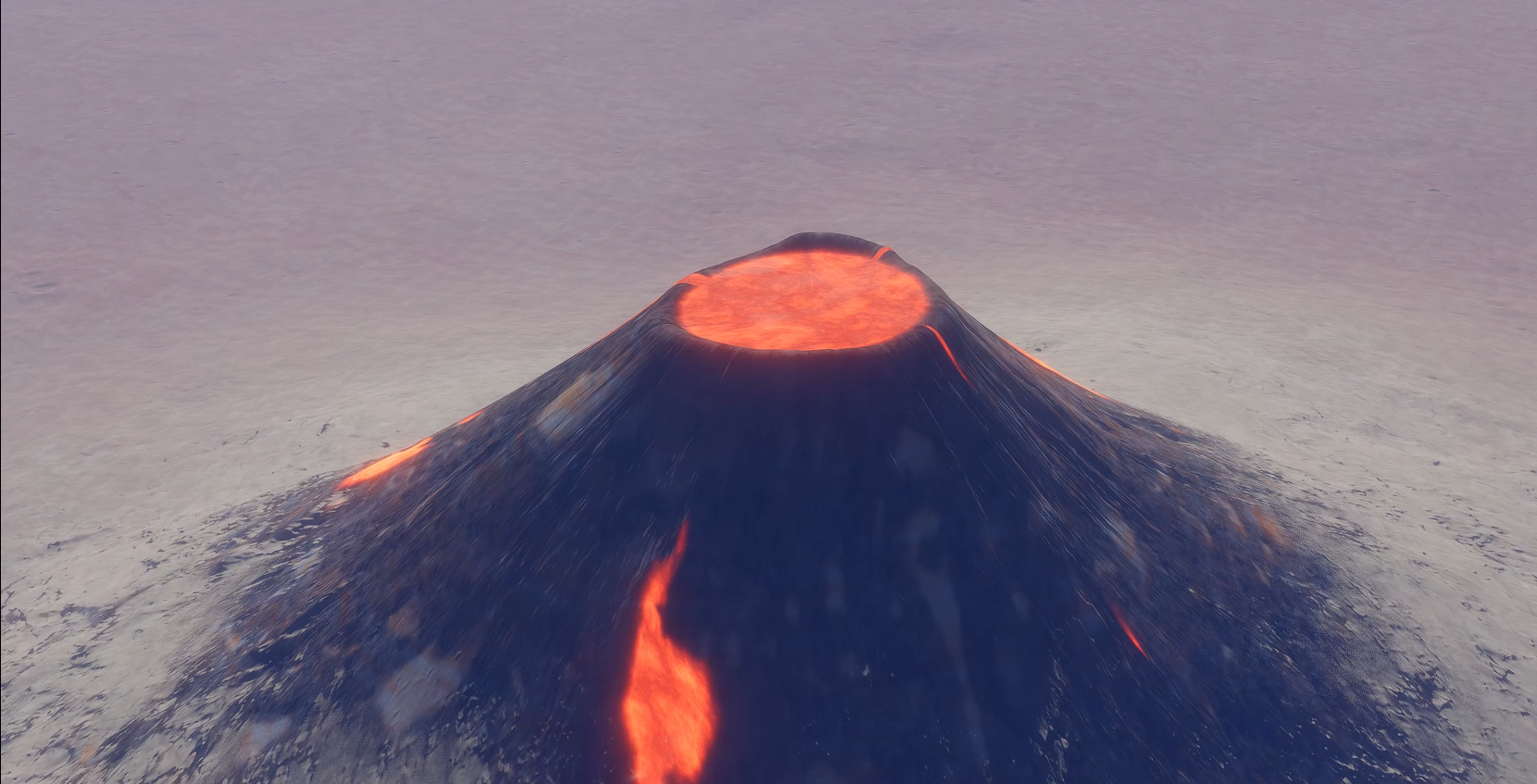
Figure: The classic form of a stratovolcano (composite volcano): a steep, symmetrical cone with a lava-filled summit crater and molten rock flowing down the flanks. This highly symmetrical profile is the product of repeated explosive eruptions of high-viscosity magma in a subduction-zone setting, building up layer upon layer over time.
Cinder cone volcanoes: Cinder cones are the most common and smallest of the main volcano types. They are built from fragments of glowing lava (cinders or scoria) ejected during eruption, which pile up around the vent into a steep-sided, roughly funnel-shaped hill. Cinder cones typically experience a single brief eruptive episode before going permanently dormant; they are the youngest and most widely distributed members of the volcanic family, often appearing in clusters around larger volcanic systems.
Calderas: A caldera is not built by eruption but formed by collapse. When a volcano empties its underlying magma chamber during a massive eruption, the unsupported summit structure collapses inward to create a large, roughly circular basin. Yellowstone and the Toba caldera in Indonesia are examples; Toba’s supereruption approximately 74,000 years ago was the largest volcanic event in the past two million years, producing ejecta equivalent to the combined output of thousands of ordinary volcanoes. Calderas represent the most destructive potential of any geological structure on Earth.
Komatiite volcanoes (Hadean only): Komatiite volcanoes have almost no counterpart on the modern Earth, yet they were the most important volcanic type in the Hadean and early Archaean [Arndt, 2003] Komatiites
Arndt, N. T. (2003)
Lithos
DOI: 10.1016/S0024-4937(03)00062-8 .
Their eruption temperatures exceeding 1,600°C meant the melt had extremely low viscosity, flowing almost like water, and could spread across the surface as extremely thin, wide sheets.
As these flows cooled they sometimes formed distinctive spinifex textures: elongated or blade-like olivine crystal networks that are a hallmark of komatiite and are found only in rocks billions of years old.
The disappearance of komatiite volcanism is the most direct rock-record evidence of the long-term cooling of Earth’s mantle.
The Legacy of Volcanism
Volcanism is commonly associated with destruction, but from a planetary-evolution perspective, it has been one of the most constructive forces in Earth’s history.
Building the atmosphere: The nitrogen, carbon dioxide, water vapour, and sulphur dioxide in Earth’s modern atmosphere did not arrive from space; they were gradually released from the Earth’s interior through volcanic degassing [Holland, 2002] Volcanic gases from subduction zones and the atmosphere and oceans of the early Earth
Holland, H. D. (2002)
Geochimica et Cosmochimica Acta
DOI: 10.1016/S0016-7037(01)00829-7 .
This process, known as outgassing, was especially intense in the early Hadean as the magma ocean cooled and solidified.
The composition of the early atmosphere was determined by the chemistry of degassing magma, making it radically different from today’s atmosphere, but the water vapour within it would ultimately condense into the first oceans [Zahnle et al., 2010] Earth's Earliest Atmospheres
Zahnle, K., Schaefer, L., Fegley, B. (2010)
Cold Spring Harbor Perspectives in Biology
DOI: 10.1101/cshperspect.a004895 .
The precursor to the oceans: A substantial body of research indicates that at least part of the water in Earth’s early oceans came from volcanic degassing of the planet’s interior, rather than being delivered solely by meteorites and comets. As the global magma ocean cooled below a critical temperature threshold, the dense water vapour in the atmosphere began to condense on a massive scale, falling as rain and accumulating into the first global ocean over the course of millions of years.
Hydrothermal vents and the cradle of life: Submarine volcanic activity created hydrothermal vent systems, through which superheated, mineral-rich fluids gush from cracks in the seafloor and create steep chemical gradients upon contact with the surrounding cold seawater [Martin et al., 2008] Hydrothermal vents and the origin of life
Martin, W., Baross, J., Kelley, D., Russell, M. J. (2008)
Nature Reviews Microbiology
DOI: 10.1038/nrmicro1991 .
These chemical imbalances provide exactly the kind of energy source that life’s metabolic processes require, and many scientists believe the first chemical reactions leading to life may have taken place in just such hydrothermal environments, requiring no sunlight, only minerals and heat.
Mineral resources and nutrient cycling: Volcanoes bring metallic elements, minerals, and trace nutrients from deep within the Earth to the surface and to the ocean. Copper, zinc, iron, sulphur, and other elements are concentrated in specific geological structures by volcanic activity, forming the metal ore deposits we extract today. Meanwhile these minerals are distributed throughout the global system by weathering and ocean circulation, providing the foundational nutrients that sustain ecosystems.
The silent, incandescent vents of the early Earth were not merely agents of destruction. They were the planet’s architects, patiently, over billions of years, transforming a molten ball of rock into a complex world of atmosphere, ocean, and life.
References
- [Arndt et al., 2012] Arndt, N. T., Nisbet, E. G.(2012). Processes on the Young Earth and the Habitats of Early Life. Annual Review of Earth and Planetary Sciences
DOI: 10.1146/annurev-earth-042711-105316 - [Arndt, 2003] Arndt, N. T.(2003). Komatiites. Lithos
DOI: 10.1016/S0024-4937(03)00062-8 - [Lockwood et al., 2010] Lockwood, J. P., Hazlett, R. W.(2010). Volcanoes: Global Perspectives. Wiley-Blackwell
DOI: 10.1002/9781444392876 - [Condie, 2001] Condie, K. C.(2001). Mantle Plumes and Their Record in Earth History. Cambridge University Press
DOI: 10.1017/CBO9780511529733 - [Elkins-Tanton, 2012] Elkins-Tanton, L. T.(2012). Magma Oceans in the Inner Solar System. Annual Review of Earth and Planetary Sciences
DOI: 10.1146/annurev-earth-042711-105503 - [Chambers, 2004] Chambers, J. E.(2004). Planetary accretion in the inner Solar System. Earth and Planetary Science Letters
DOI: 10.1016/j.epsl.2004.04.031 - [Kleine et al., 2002] Kleine, T., Münker, C., Mezger, K., Palme, H.(2002). Rapid accretion and early core formation on asteroids and the terrestrial planets from Hf–W chronometry. Nature
DOI: 10.1038/nature00982 - [Zahnle et al., 2010] Zahnle, K., Schaefer, L., Fegley, B.(2010). Earth's Earliest Atmospheres. Cold Spring Harbor Perspectives in Biology
DOI: 10.1101/cshperspect.a004895 - [Holland, 2002] Holland, H. D.(2002). Volcanic gases from subduction zones and the atmosphere and oceans of the early Earth. Geochimica et Cosmochimica Acta
DOI: 10.1016/S0016-7037(01)00829-7 - [Martin et al., 2008] Martin, W., Baross, J., Kelley, D., Russell, M. J.(2008). Hydrothermal vents and the origin of life. Nature Reviews Microbiology
DOI: 10.1038/nrmicro1991
Responses are welcome. Please keep comments thoughtful and relevant.