
How Earth's Oceans Formed: The Birth of the Oceans in the Hadean Eon
Keywords: early oceans, Hadean ocean, origin of Earth’s water, zircon evidence, volcanic outgassing, cometary water, carbonaceous chondrites, deuterium-to-hydrogen ratio, hydrothermal vents, origin of life
Over 70% of Earth’s surface is covered by ocean. This vast expanse of blue is the fundamental basis for life on Earth: the oceans regulate the climate, dissolve atmospheric gases, supply essential minerals, and are very likely where life itself first arose, billions of years ago. Yet the oceans were not always there. For hundreds of millions of years after Earth first formed, surface temperatures were so high that liquid water could not exist. The water vapour in the thick early atmosphere waited, suspended, for the world to cool.
This is the story of water’s journey: carried in from the outermost reaches of the Solar System, trapped and then released from within a scorching planet, and finally condensed into rain, pooling into the first ocean on a slowly cooling world.
Where Did the Water Come From?
Before we can discuss how the oceans formed, we need to answer a more fundamental question: where did Earth’s water come from in the first place?
This deceptively simple question has driven decades of debate in planetary science. Today, the mainstream view holds that Earth’s water came from two main sources: volcanic outgassing from Earth’s interior, and water-bearing impactors from the outer Solar System.
Internal Source: Volcanic Outgassing
During Earth’s accretion phase, vast amounts of hydroxyl-bearing minerals (containing OH groups) were buried within Earth’s interior. As the magma ocean cooled and convection evolved inside the planet, these bound water molecules were gradually released through volcanic eruptions, entering the atmosphere as water vapour and ultimately contributing to the oceans [Holland, 2002] Volcanic gases from subduction zones and the atmosphere and oceans of the early Earth
Holland, H. D. (2002)
Geochimica et Cosmochimica Acta
DOI: 10.1016/S0016-7037(01)00829-7 .
Volcanic outgassing is ongoing even today. Modern volcanic eruptions still release significant quantities of water vapour. In the early Hadean, with a hotter interior and far more intense volcanism, the rate of outgassing far exceeded anything seen today.
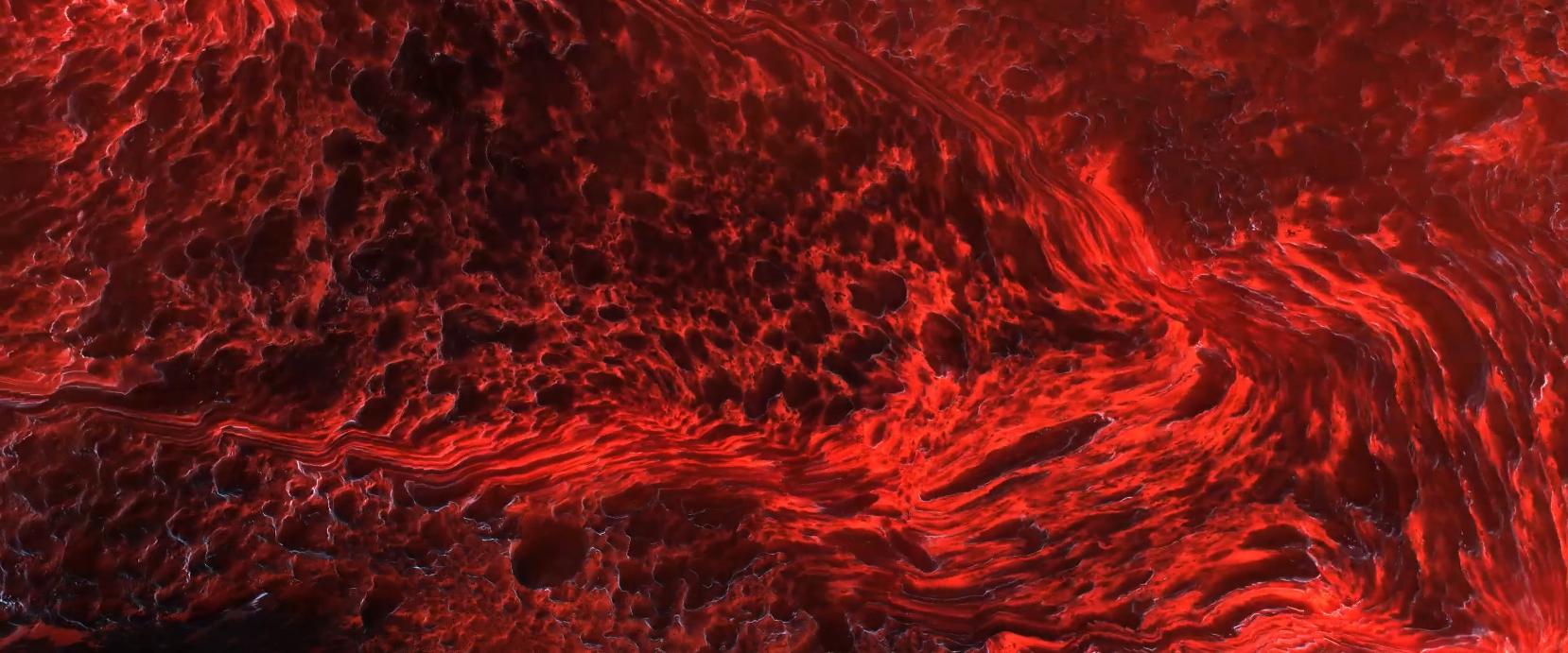
Volcanic lava flow: In the Hadean, active volcanism was widespread across Earth’s surface. Erupting magma released not only large quantities of water vapour but also CO₂, SO₂, and other volatile gases, gradually building the second-generation atmosphere and accumulating the raw material for the future oceans.
[Volcano Simulator, 2026] Volcano Lava Flow SimulationVolcano Simulator (2026)
External Source: Comets and Carbonaceous Chondrites
Volcanic outgassing alone may not fully account for the total volume of Earth’s oceans. A second important source lay beyond Earth itself: ice-rich comets and carbonaceous chondrite meteorites from the outer asteroid belt [Marty, 2012] The origins of water and carbon in the terrestrial planets
Marty, B. (2012)
Earth and Planetary Science Letters
DOI: 10.1016/j.epsl.2011.11.025 .
Carbonaceous chondrites (C-type meteorites) can contain up to 10–20% water by weight. They formed in the cold outer regions of the Solar System and were flung into the inner Solar System during the turbulent early period, delivering their water and organic compounds directly into the Earth system upon impact.
The Hydrogen Isotope Fingerprint
The key to distinguishing internal from external water lies in hydrogen isotope ratios. Water molecules contain two stable isotopes of hydrogen: ordinary hydrogen (¹H) and deuterium (²H, symbol D). Scientists use the D/H ratio to trace the origin of water, because water that formed in different regions of the Solar System carries different D/H signatures:
Earth’s ocean water has a D/H ratio of approximately (the so-called SMOW standard) (Standard Mean Ocean Water) [Marty, 2012] The origins of water and carbon in the terrestrial planets
Marty, B. (2012)
Earth and Planetary Science Letters
DOI: 10.1016/j.epsl.2011.11.025 . Short-period comets such as Halley’s Comet typically have D/H values about twice as high as Earth’s oceans, while carbonaceous chondrites from the outer asteroid belt closely match the oceanic value.
This strongly supports the conclusion that Earth’s oceans were predominantly sourced from carbonaceous-chondrite-type impactors rather than from comets. The reality is likely more complex. Earth’s water probably represents a combination of volcanic outgassing, carbonaceous chondrites, and a smaller cometary component, with the relative contributions still an active area of research.
From Water Vapour to Liquid Ocean
Wherever it came from, during the early Hadean, Earth’s water could not exist as liquid on the surface. The reason was straightforward: it was too hot.
During the magma ocean phase and the subsequent period of large impacts, surface temperatures far exceeded the boiling point of water. All water existed as vapour in the atmosphere, alongside vast quantities of CO₂, forming a thick greenhouse atmosphere [Zahnle et al., 2010] Earth's Earliest Atmospheres
Zahnle, K., Schaefer, L., Fegley, B. (2010)
Cold Spring Harbor Perspectives in Biology
DOI: 10.1101/cshperspect.a004895 . This vapour-laden early atmosphere generated an intense greenhouse effect, keeping the surface temperature hundreds of degrees above the condensation point of water, creating a self-reinforcing equilibrium: high temperatures prevented condensation, while the abundant water vapour in the atmosphere sustained the high temperatures through the greenhouse effect.
The Trigger for Cooling and the First Rainfall
This equilibrium was eventually broken by the gradual decline in large impacts. As the reservoir of impactable material in the Solar System was depleted, the energy input to Earth’s surface decreased, and the planet began to cool by radiating heat into space.
When the surface temperature dropped sufficiently for water vapour to begin condensing, a critical turning point was reached. Thermodynamically, condensation occurs when the partial pressure of water vapour in the atmosphere exceeds the saturation vapour pressure, which varies with temperature according to the Clausius–Clapeyron equation:
where is the saturation vapour pressure, is temperature, is the latent heat of vaporisation, and is the specific gas constant for water vapour. This means a small drop in temperature causes a sharp decrease in saturation vapour pressure: once the atmospheric water vapour partial pressure exceeds saturation, condensation begins, water droplets form, and rain falls.
The earliest rainfall would have hit scorching ground and immediately re-evaporated, but the latent heat carried away by evaporation would itself help cool the surface further. This is a positive feedback process: cooling promotes rainfall, rainfall assists cooling, until eventually the surface temperature drops low enough that liquid water begins to accumulate.
Rainfall Over Millions of Years
This cooling and condensation process was not sudden; it was extraordinarily slow. Models estimate that the complete condensation of atmospheric water vapour may have taken millions of years [Sleep et al., 2001] Initiation of clement surface conditions on the earliest Earth
Sleep, N. H., Zahnle, K., Neuhoff, P. S. (2001)
Proceedings of the National Academy of Sciences
DOI: 10.1073/pnas.221424498 . During this time, Earth experienced sustained, global-scale rainfall: an uninterrupted deluge covering the entire surface of the planet.
The water from this primordial rain gradually pooled in low-lying regions of Earth’s surface. Since the surface at this time had not yet clearly differentiated into continents and ocean basins, the early ocean may have existed as a relatively uniform, globally distributed shallow sea: a true world ocean.

Space Engine simulation of early Hadean Earth cloud cover, viewed from above. Dense orange-pink cloud masses spiral on a global scale, a thick water-vapour atmosphere enveloping the entire planet. It was within this cloud layer that water vapour condensed over millions of years, falling as rain and ultimately pooling into Earth’s earliest ocean.
[Space Engine, 2026] Hadean Cloud Cover – Space Engine ScreenshotSpace Engine / SpaceEngineSoftware (2026)
Geological Evidence for the Earliest Oceans: Testimony of the Zircons
If Earth’s earliest oceans formed in the Hadean, how do we know? The rocks of that period have almost entirely vanished. Plate tectonics has repeatedly melted and reshaped the early crust, leaving virtually no direct evidence.
The answer lies in one of the hardest and most chemically stable minerals: zircon (ZrSiO₄).
Zircon can preserve its crystal structure through melting and recrystallisation events, remaining virtually unreactive with its chemical environment. More importantly, the uranium–lead isotope system within zircon allows precise dating of its formation age, while trace oxygen isotope signatures locked inside the crystal can reveal whether liquid water was present in the environment when the zircon formed.
Jack Hills Zircons: A Record of Water 4.3 Billion Years Ago
Zircon grains from the Jack Hills region of Western Australia are the oldest known materials on Earth. Uranium–lead isotope dating places their formation at approximately 4.3 billion years ago, only about 300 million years after Earth itself formed [Valley, 2014] Hadean age for a post-magma-ocean zircon confirmed by atom-probe tomography
Valley, J. W. et al. (2014)
Nature Geoscience
DOI: 10.1038/ngeo2075 .
The oxygen isotope signal within these zircons is even more remarkable. The ratio of two stable oxygen isotopes (¹⁶O and ¹⁸O), expressed as the δ¹⁸O value, is highly sensitive to the temperature and chemical environment at the time of crystallisation. Zircons enriched in ¹⁸O can only form in low-temperature crustal environments where liquid water was involved, because the interaction of liquid water with rock drives a characteristic oxygen isotope fractionation [Valley, 2014] Hadean age for a post-magma-ocean zircon confirmed by atom-probe tomography
Valley, J. W. et al. (2014)
Nature Geoscience
DOI: 10.1038/ngeo2075 .
Jack Hills zircons show δ¹⁸O values of +5 to +7‰ (relative to the VSMOW standard), significantly higher than typical mantle zircons (~+5.3‰). This signal strongly implies that these zircons crystallised under conditions where liquid water was present.
In other words: approximately 4.3 billion years ago, liquid water already existed on Earth’s surface. The ocean had already been born.
Chemistry of the Early Ocean
Today’s oceans are mildly alkaline (pH ~8.1), contain about 3.5% dissolved salts, and range from −2°C to 30°C. The early Hadean ocean was radically different.
An Acidic Ocean
When the atmospheric water vapour condensed to form the first oceans, the enormous quantity of CO₂ in the atmosphere dissolved rapidly into the newly formed seawater, forming carbonic acid (H₂CO₃), which dissociated into hydrogen ions (H⁺) and bicarbonate (HCO₃⁻):
Atmospheric CO₂ concentrations in the Hadean are estimated to have been hundreds to thousands of times higher than today [Zahnle et al., 2010] Earth's Earliest Atmospheres
Zahnle, K., Schaefer, L., Fegley, B. (2010)
Cold Spring Harbor Perspectives in Biology
DOI: 10.1101/cshperspect.a004895 . Such high CO₂ concentrations dissolving into seawater would have pushed the early ocean pH far below modern values, possibly as low as 3 to 5, a strongly acidic environment [Sleep et al., 2001] Initiation of clement surface conditions on the earliest Earth
Sleep, N. H., Zahnle, K., Neuhoff, P. S. (2001)
Proceedings of the National Academy of Sciences
DOI: 10.1073/pnas.221424498 .
This acidity did not last forever. As acidic ocean water reacted with seafloor rocks (silicate weathering), CO₂ was gradually removed from the atmosphere–ocean system and deposited as carbonate minerals on the seafloor. Over millions of years, atmospheric CO₂ concentrations declined and ocean pH rose, trending toward the mildly alkaline modern ocean.
Hot and Anoxic
The early ocean was not only acidic but also hot. Ocean surface temperatures around 4 billion years ago are estimated to have been around 70–80°C [Sleep et al., 2001] Initiation of clement surface conditions on the earliest Earth
Sleep, N. H., Zahnle, K., Neuhoff, P. S. (2001)
Proceedings of the National Academy of Sciences
DOI: 10.1073/pnas.221424498 . The early ocean also contained no free oxygen (O₂), consistent with the atmosphere of the time: dissolved gases in the seawater were primarily CO₂, N₂, and small amounts of H₂S from seafloor hydrothermal activity.
| Property | Early Hadean ocean (~4 Ga) | Modern ocean |
|---|---|---|
| pH | ~3–5 (strongly acidic) | ~8.1 (mildly alkaline) |
| Surface temperature | ~70–80°C | ~17°C (global average) |
| Dissolved O₂ | Near zero | ~7–8 mg/L |
| Dissolved CO₂ | Extremely high (equilibrium with high-CO₂ atmosphere) | ~1.4 mmol/L |
| Salinity | Possibly similar to or slightly higher than today | ~35 g/kg |
| Major dissolved metal ions | Predominantly reducing ions: Fe²⁺, Mg²⁺ | Predominantly Na⁺, Cl⁻ |
The Late Heavy Bombardment: The Ocean Nearly Evaporated
Just as the earliest ocean formed, a devastating wave of impacts was to follow.
Around 3.9 billion years ago, the Solar System experienced a period of intense bombardment known as the Late Heavy Bombardment (LHB) [Gomes et al., 2005] Origin of the cataclysmic Late Heavy Bombardment period of the terrestrial planets
Gomes, R., Levison, H. F., Tsiganis, K., Morbidelli, A. (2005)
Nature
DOI: 10.1038/nature03676 . During this event, gravitational resonances with Jupiter and other giant planets drove large numbers of asteroids and comets out of their original orbits and into the inner Solar System, generating a concentrated barrage against Earth, the Moon, and the other terrestrial planets. The large impact basins still visible on the Moon today (Mare Imbrium, Mare Serenitatis, and others) were largely formed during this period.
Could Giant Impacts Evaporate the Ocean?
Theoretical calculations show that a sufficiently large impactor could release enough energy to completely evaporate Earth’s entire ocean [Sleep et al., 2001] Initiation of clement surface conditions on the earliest Earth
Sleep, N. H., Zahnle, K., Neuhoff, P. S. (2001)
Proceedings of the National Academy of Sciences
DOI: 10.1073/pnas.221424498 . The energy required to heat the ocean (total mass ~ kg) from its average temperature to complete vaporisation is approximately:
where is the latent heat of vaporisation of water. This is comparable to the kinetic energy released by an impactor roughly 500 km in diameter travelling at 20 km/s.
Even if the ocean was partially or largely evaporated by a giant impact, however, the evaporated water vapour would eventually re-condense, because steam that escaped into the atmosphere never reached Earth’s escape velocity and would inevitably fall back. Zircon evidence indicates that liquid water was present on Earth’s surface even during the Late Heavy Bombardment, suggesting that the ocean reformed after each such event.
Cradle of Life: Hydrothermal Vents and the Early Ocean
Among all the questions raised by the early Earth, perhaps the most compelling is: how did life arise in this young ocean?
On the deep seafloor today, special geological structures known as hydrothermal vents release mineral-rich hot water from within the crust [Martin et al., 2008] Hydrothermal vents and the origin of life
Martin, W., Baross, J., Kelley, D., Russell, M. J. (2008)
Nature Reviews Microbiology
DOI: 10.1038/nrmicro1991 . These vents create intense temperature and chemical gradients where the hot, chemically enriched vent fluids meet the cold surrounding deep water. Within these gradients lies a natural source of chemical energy: reducing gases from Earth’s interior (such as H₂S and H₂) meet oxidising compounds from the surrounding seawater (such as CO₂), and spontaneous chemical reactions release free energy that primitive cells could harvest:
In the Hadean, such hydrothermal vent systems were likely extremely active. Some scientists argue that the origin of life may have occurred in exactly this kind of deep-sea hydrothermal environment, rather than in a surface “primordial soup” [Martin et al., 2008] Hydrothermal vents and the origin of life
Martin, W., Baross, J., Kelley, D., Russell, M. J. (2008)
Nature Reviews Microbiology
DOI: 10.1038/nrmicro1991 . Hydrothermal vents provide a continuous, stable source of chemical energy, mineral catalysts, and shielding from surface UV radiation, satisfying many of the conditions required for life’s emergence.
Wherever life first arose, the existence of liquid water (an ocean) was the absolute prerequisite for life on Earth. Without an ocean, there would be no life.
The Legacy of the Hadean
Earth’s earliest oceans formed approximately 4.3 to 4.4 billion years ago, within only ~100 million years of Earth’s formation. This conclusion rests on the isotopic signals preserved in Jack Hills zircon grains from Western Australia, some of the tiniest but most ancient witnesses to Earth’s history.
This primordial ocean looked nothing like the oceans of today: it was acidic, hot, anoxic, rich in CO₂, and disturbed by violent volcanism and constant meteorite impacts. But it was liquid water: Earth’s first crucible in which countless chemical molecules were brought together.
Since then, Earth’s oceans have transformed over billions of years: steadily becoming less acidic, cooling gradually, giving rise to life, receiving oxygen injected into the atmosphere and ocean by the rise of biological photosynthesis around 2.4 billion years ago, and ultimately becoming the vibrant blue world we know today.
References
- [Marty, 2012] Marty, B.(2012). The origins of water and carbon in the terrestrial planets. Earth and Planetary Science Letters
DOI: 10.1016/j.epsl.2011.11.025 - [Holland, 2002] Holland, H. D.(2002). Volcanic gases from subduction zones and the atmosphere and oceans of the early Earth. Geochimica et Cosmochimica Acta
DOI: 10.1016/S0016-7037(01)00829-7 - [Zahnle et al., 2010] Zahnle, K., Schaefer, L., Fegley, B.(2010). Earth's Earliest Atmospheres. Cold Spring Harbor Perspectives in Biology
DOI: 10.1101/cshperspect.a004895 - [Valley, 2014] Valley, J. W. et al.(2014). Hadean age for a post-magma-ocean zircon confirmed by atom-probe tomography. Nature Geoscience
DOI: 10.1038/ngeo2075 - [Sleep et al., 2001] Sleep, N. H., Zahnle, K., Neuhoff, P. S.(2001). Initiation of clement surface conditions on the earliest Earth. Proceedings of the National Academy of Sciences
DOI: 10.1073/pnas.221424498 - [Gomes et al., 2005] Gomes, R., Levison, H. F., Tsiganis, K., Morbidelli, A.(2005). Origin of the cataclysmic Late Heavy Bombardment period of the terrestrial planets. Nature
DOI: 10.1038/nature03676 - [Martin et al., 2008] Martin, W., Baross, J., Kelley, D., Russell, M. J.(2008). Hydrothermal vents and the origin of life. Nature Reviews Microbiology
DOI: 10.1038/nrmicro1991 - [Volcano Simulator, 2026] Volcano Simulator(2026). Volcano Lava Flow Simulation
Link - [Space Engine, 2026] Space Engine / SpaceEngineSoftware(2026). Hadean Cloud Cover – Space Engine Screenshot
Link
Responses are welcome. Please keep comments thoughtful and relevant.