How Earth's Atmosphere Formed: Origins of the Hadean Atmosphere
Keywords: Hadean atmosphere, early Earth atmosphere, volcanic outgassing, solar wind stripping, nebular gas, Late Heavy Bombardment, magnetic field protection, origin of atmosphere
Every breath we take depends on that thin layer of gas enveloping Earth’s surface. It is so familiar that we rarely stop to wonder where it came from. In fact, Earth’s atmosphere today was not there from the beginning — it took billions of years of upheaval to take shape. In Earth’s earliest history, the atmosphere was torn apart by stellar winds, vaporised by impacts, expelled from a scorching interior, and time and again destroyed and rebuilt. This is a story of destruction and renewal, unfolding some 4.5 to 4.0 billion years ago during the Hadean eon.
The First Atmosphere: Nebular Gas Stripped by the Young Sun
In the very earliest stages of Earth’s formation, the young planet was not naked in the void.
The protoplanetary disk was filled with abundant hydrogen and helium — residual gas from the solar nebula that had not yet dispersed.
As Earth accreted, its gravity was sufficient to accumulate a primitive “nebular atmosphere” composed mainly of hydrogen and helium around itself [Zahnle et al., 2010] Earth's Earliest Atmospheres
Zahnle, K., Schaefer, L., Fegley, B. (2010)
Cold Spring Harbor Perspectives in Biology
DOI: 10.1101/cshperspect.a004895 .
Yet this atmosphere was extraordinarily short-lived. The core of the problem lies in a physical reality: for lighter gas molecules, Earth’s gravity is simply not strong enough to hold them indefinitely. For a gas molecule of mass at Earth’s surface, the escape velocity is:
where is the gravitational constant, is Earth’s mass, and is Earth’s radius.
For today’s Earth, .
Yet the thermal velocities of hydrogen and helium atoms in a hot gas can approach or even exceed this value [Catling et al., 2009] The Planetary Air Leak
Catling, D. C., Zahnle, K. J. (2009)
Scientific American
DOI: 10.1038/scientificamerican0509-36 .
In the upper atmosphere, these light particles can continuously escape to space through a process known as Jeans escape.
The more devastating blow came from the young Sun itself. Within the first few million years after the Solar System formed, the Sun was in what is known as its T Tauri phase. During this phase, the solar wind was hundreds to thousands of times more powerful than it is today, blasting charged particles outward at extreme velocities. This intense stellar wind swept through the inner Solar System, dispersing the residual light gases from the disk. The thin nebular hydrogen-helium atmosphere at Earth’s surface was powerless against this stellar wind and was stripped away entirely. The entire process took only a few million years — a fleeting instant compared to Earth’s 4.5-billion-year history.
The first atmosphere was gone.
Impacts and the Magma Ocean: A Sky of Steam
With the nebular atmosphere gone, early Earth did not find peace. As described in our previous post, the planet was undergoing continuous large-scale bombardment, its surface covered by a vast magma ocean.
In this environment, what passed for an “atmosphere” was not composed of stable gas molecules, but was instead an extreme medium formed from vaporised rock and minerals [Zahnle et al., 2010] Earth's Earliest Atmospheres
Zahnle, K., Schaefer, L., Fegley, B. (2010)
Cold Spring Harbor Perspectives in Biology
DOI: 10.1101/cshperspect.a004895 .
When fast-moving planetesimals and planetary embryos slammed into the molten surface, the energy released was sufficient to instantly vaporise enormous quantities of rock. Iron, magnesium, silicon, and other components of silicate rocks entered the gas phase at temperatures of thousands of Kelvin. At the same time, water from accreted material existed only as steam at these temperatures, unable to condense. The entire surface of the Earth was shrouded in a thick atmosphere composed of rock vapour, water vapour, and various mineral gases.
This atmosphere had an extremely powerful greenhouse effect. Like a heavy blanket, it trapped radiation from impacts and internal heat near Earth’s surface, keeping surface temperatures extremely high for a prolonged period and further preventing cooling and solidification.
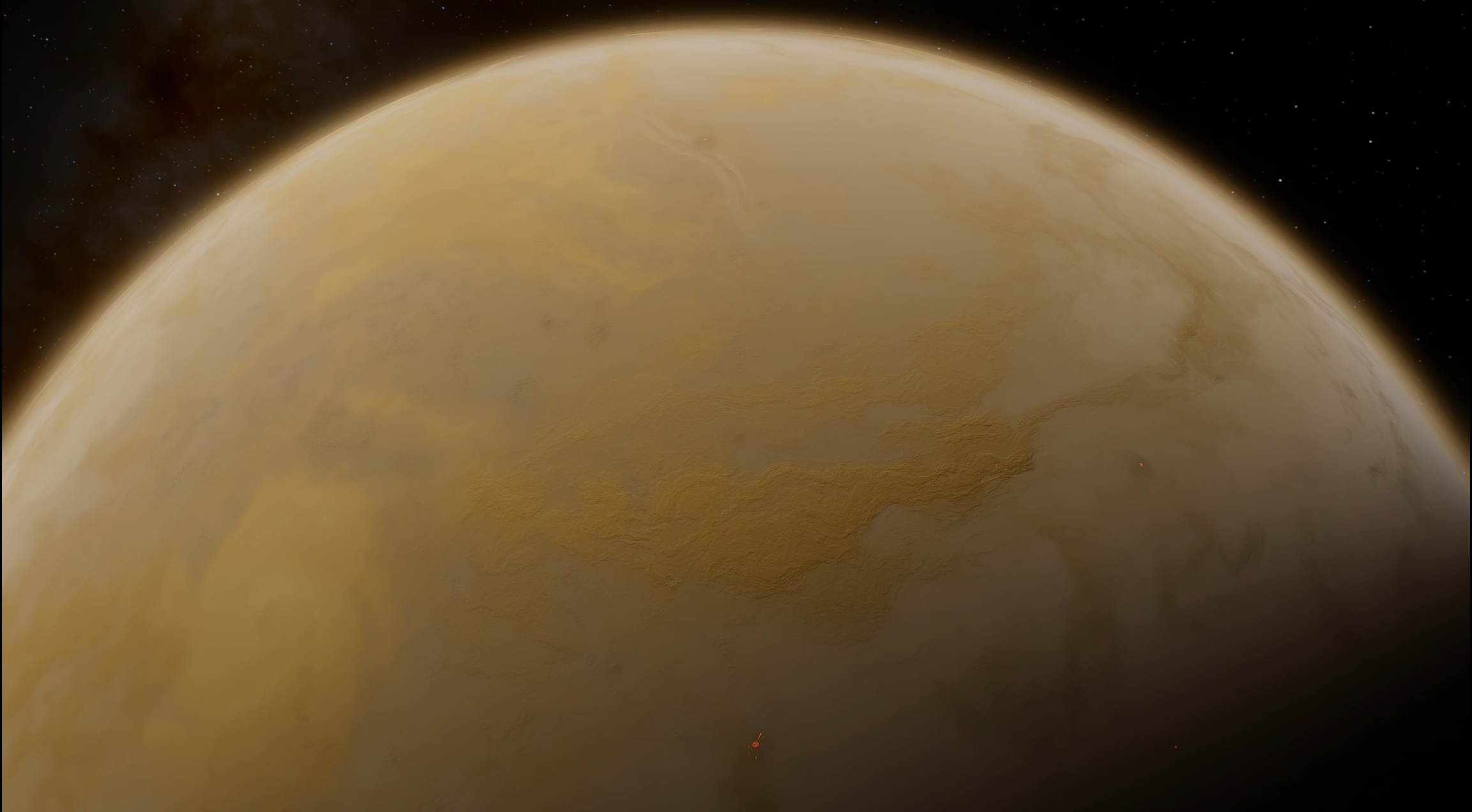
Figure: Early Earth’s surface was enveloped by a thick mixture of gases. During the magma ocean phase, the atmosphere consisted of rock vapour, water vapour, and various volatile gases — the entire surface was unable to solidify. This extreme atmosphere was a defining feature of early Hadean Earth.
The Second Atmosphere: Gas from Earth’s Interior
As the frequency of large impacts gradually declined, Earth’s surface began to cool slowly.
Rock vapour condensed first, falling back to the surface to form the rudiments of an early crust.
Water vapour still existed in the gas phase because surface temperatures remained above the boiling point of water.
But the most important change was that Earth’s interior began releasing gas to the surface in a systematic way — a process known as volcanic outgassing [Holland, 2002] Volcanic gases from subduction zones and the atmosphere and oceans of the early Earth
Holland, H. D. (2002)
Geochimica et Cosmochimica Acta
DOI: 10.1016/S0016-7037(01)00829-7 .
Early Earth’s interior contained large quantities of volatile substances sealed within it during accretion. As differentiation proceeded (see our previous post on planet formation), these volatiles were driven to the surface by mantle convection and volcanic activity and released into the atmosphere through magma eruptions. This process continued for billions of years and remains one of the primary mechanisms by which Earth’s atmosphere was constructed.
The composition of early volcanic gases differed from modern volcanic emissions. Today’s mantle has undergone a long evolution; the early Hadean mantle was hotter and less oxidised, so the gases it released were predominantly reducing:
| Gas | Formula | Estimated fraction (vol%) | Significance |
|---|---|---|---|
| Water vapour | H₂O | 50–80 | Primary source of the oceans after condensation |
| Carbon dioxide | CO₂ | 10–40 | Main greenhouse gas; later dissolved into seawater |
| Nitrogen | N₂ | 1–5 | Chemically inert; accumulated to form the bulk of the atmosphere |
| Sulfur dioxide | SO₂ | 1–5 | Important component during periods of intense volcanism |
| Methane | CH₄ | <1 | Marker of a reducing atmosphere; present in trace amounts |
| Hydrogen | H₂ | <1 | Light; continuously escaped to space |
Notably, this early atmosphere contained no free oxygen (O₂) whatsoever. All oxygen existed in compound form — as water, carbon dioxide, and sulfur dioxide. This was a strongly reducing atmospheric environment, utterly unlike today’s oxygen-rich air. The appearance of free oxygen would come billions of years later, as the product of life remaking the planet, not as a natural outcome of Earth’s initial formation.
The Dual Role of Impacts: Destruction and Replenishment
Volcanic outgassing was building Earth a new atmosphere, but this work proceeded far from quietly.
In the late Hadean, approximately 3.9 billion years ago, the Solar System experienced an intense episode of bombardment known as the Late Heavy Bombardment (LHB) [Gomes et al., 2005] Origin of the cataclysmic Late Heavy Bombardment period of the terrestrial planets
Gomes, R., Levison, H. F., Tsiganis, K., Morbidelli, A. (2005)
Nature
DOI: 10.1038/nature03676 .
During this period, large numbers of asteroids and comets had their orbits severely perturbed by gravitational resonances with Jupiter and other giant planets, sending swarms of objects into the inner Solar System.
Each large-scale impact caused direct damage to the atmosphere. When a sufficiently large asteroid struck Earth at extreme velocity, the explosive shockwave could accelerate large quantities of atmospheric gas above escape velocity, stripping it permanently from Earth’s gravitational hold. This process is called atmospheric erosion. The larger and faster the impactor, the more severe the atmospheric loss.
Yet impacts were not only destructive. These impactors from the outer Solar System — especially volatile-rich comets and carbonaceous chondrites — carried large quantities of ice, organic molecules, and other volatile compounds [Marty, 2012] The origins of water and carbon in the terrestrial planets
Marty, B. (2012)
Earth and Planetary Science Letters
DOI: 10.1016/j.epsl.2011.11.025 .
When they struck Earth, the materials they carried were released, replenishing the atmosphere and hydrosphere with new raw materials.
The most significant contribution may have been water. A portion of the water in today’s oceans may well have been delivered by these distant impactors.
This is a deeply paradoxical and remarkable fact: the very same impacts were both the destroyers and the builders of the atmosphere.
The Magnetic Field: Guardian of the Atmosphere
The survival of the atmosphere depended not only on continuous replenishment from Earth’s interior, but also on a protective shield from above. That shield is Earth’s magnetic field.
As described in our previous post, planetary differentiation gave Earth a liquid iron-nickel outer core.
Driven by Earth’s rotation, convecting electrically conductive fluid in the outer core generates a magnetic field through the dynamo effect.
This field extends into space, forming the magnetosphere — an invisible shield that deflects most of the charged particles streaming from the Sun (the solar wind) [Tarduno, 2010] Geodynamo, Solar Wind, and Magnetopause 3.4 to 3.45 Billion Years Ago
Tarduno, J. A. et al. (2010)
Science
DOI: 10.1126/science.1183445 .
Without a magnetic field, the high-energy charged particles in the solar wind would continuously bombard Earth’s upper atmosphere, steadily stripping away gas molecules and causing the atmosphere to slowly but irreversibly bleed into space. This is not theoretical speculation — it is a phenomenon we can observe directly elsewhere in the Solar System: Mars is the most striking example.
Mars also had an active internal dynamo and a global magnetic field in the early Solar System. However, because Mars is smaller, its interior cooled faster, and its liquid iron core solidified approximately 4 billion years ago, shutting down the dynamo. Without the protection of a magnetic field, Mars’s atmosphere was continuously eroded by the solar wind over the following billions of years — transforming from a world that may once have had liquid water and a thick atmosphere into the thin-aired, dry, frozen red desert we see today.
Earth took a radically different path. Earth is larger, cools more slowly, and its liquid outer core remains active to this day. This has allowed Earth’s magnetic field to exist continuously and stably for billions of years, providing the indispensable long-term protection that allowed the atmosphere to accumulate.
Late Hadean: The Atmosphere Takes Shape
As we move into the late Hadean, around 4 billion years ago, the frequency of large-scale impacts gradually declined and Earth’s surface entered a relatively more stable phase. The continuous accumulation from volcanic outgassing, the volatile replenishment from impactors, and the sustained deflection of solar wind by the magnetic field worked together to give Earth’s atmosphere a relatively stable form.
This atmosphere looked almost nothing like today’s.
The main components were carbon dioxide (CO₂) and nitrogen (N₂), with CO₂ concentrations orders of magnitude higher than today.
Large quantities of water vapour (H₂O) still existed in the gas phase because surface temperatures remained high.
Methane (CH₄) and other reducing gases were present in trace amounts, making the overall environment strongly reducing.
Most importantly: there was no free oxygen in the atmosphere at all [Zahnle et al., 2010] Earth's Earliest Atmospheres
Zahnle, K., Schaefer, L., Fegley, B. (2010)
Cold Spring Harbor Perspectives in Biology
DOI: 10.1101/cshperspect.a004895 .
This CO₂- and N₂-dominated reducing atmosphere had a powerful greenhouse effect. Given that the Sun at that time was approximately 20–30% less luminous than today, it was precisely this greenhouse effect that kept Earth’s surface temperature within a habitable range rather than freezing into a solid snowball. This paradox — a faint young Sun, yet an unfrozen Earth — is explained by the insulating effect of early high-concentration greenhouse gases such as CO₂.
The oxygen we breathe today would not appear in the atmosphere until the Great Oxidation Event approximately 2.4 billion years ago. And that will be the beginning of another long story — the story of how life itself transformed Earth’s atmosphere forever.
References
- [Zahnle et al., 2010] Zahnle, K., Schaefer, L., Fegley, B.(2010). Earth's Earliest Atmospheres. Cold Spring Harbor Perspectives in Biology
DOI: 10.1101/cshperspect.a004895 - [Catling et al., 2009] Catling, D. C., Zahnle, K. J.(2009). The Planetary Air Leak. Scientific American
DOI: 10.1038/scientificamerican0509-36 - [Holland, 2002] Holland, H. D.(2002). Volcanic gases from subduction zones and the atmosphere and oceans of the early Earth. Geochimica et Cosmochimica Acta
DOI: 10.1016/S0016-7037(01)00829-7 - [Gomes et al., 2005] Gomes, R., Levison, H. F., Tsiganis, K., Morbidelli, A.(2005). Origin of the cataclysmic Late Heavy Bombardment period of the terrestrial planets. Nature
DOI: 10.1038/nature03676 - [Marty, 2012] Marty, B.(2012). The origins of water and carbon in the terrestrial planets. Earth and Planetary Science Letters
DOI: 10.1016/j.epsl.2011.11.025 - [Tarduno, 2010] Tarduno, J. A. et al.(2010). Geodynamo, Solar Wind, and Magnetopause 3.4 to 3.45 Billion Years Ago. Science
DOI: 10.1126/science.1183445 - [Kleine et al., 2002] Kleine, T., Münker, C., Mezger, K., Palme, H.(2002). Rapid accretion and early core formation on asteroids and the terrestrial planets from Hf–W chronometry. Nature
DOI: 10.1038/nature00982 - [Chambers, 2004] Chambers, J. E.(2004). Planetary accretion in the inner Solar System. Earth and Planetary Science Letters
DOI: 10.1016/j.epsl.2004.04.031 - [Dalrymple, 2001] Dalrymple, G. B.(2001). The age of the Earth in the twentieth century. Geological Society of London Special Publications
DOI: 10.1144/GSL.SP.2001.190.01.14
Responses are welcome. Please keep comments thoughtful and relevant.