How Earth Formed: From Cosmic Dust to a Molten Planet (Hadean Earth Explained)
Keywords: early Earth formation, accretion, Hadean Earth, planetary differentiation
Since the Neolithic Revolution, human history spans roughly twelve thousand years.
It was then that our ancestors began to transition from a nomadic life to settled communities, gradually forming villages, and from there, the earliest cities and states. [2015] The Neolithic Revolution
(2015)
Encyclopædia Britannica
But long before humans ever appeared, Earth had already begun its own story. When we speak of Earth’s history, we must go back much further, all the way to 4.6 billion years ago [Dalrymple, 2001] The age of the Earth in the twentieth century
Dalrymple, G. B. (2001)
Geological Society of London Special Publications
DOI: 10.1144/GSL.SP.2001.190.01.14 .
Early Earth Formation: From Dust to Planetary Embryos
Shortly after the birth of the Solar System, there was no giant spherical planet as we know it today. Instead, there was a vast, rotating disk of gas and dust (the protoplanetary disk) surrounding the newborn Sun [Williams et al., 2011] Protoplanetary disks and their evolution
Williams, J. P., Cieza, L. A. (2011)
Annual Review of Astronomy and Astrophysics
DOI: 10.1146/annurev-astro-081710-102548 .
The Solar System was filled with countless tiny dust grains drifting within the protoplanetary disc.
The diameter of these dust grains was only a few microns.
This marked the beginning of planetary formation, a process that would transform scattered debris into a coherent world through a series of collisions, mergers, and gravitational interactions.
Our planet, the Earth, was born from these dust grains.
Within the protoplanetary disc, microscopic dust grains began to collide and stick together.
Over time, these collisions built progressively larger aggregates, marking the first step of planetary formation.
The process shares a simple principle with life itself: nothing appears from nothing. A living organism grows by taking in material from its surroundings and reorganizing it into new structure. Earth formed in the same way: by continuously gathering and reshaping existing matter.
At first, there was no single object at all, only countless microscopic grains distributed throughout the disk.
In the protoplanetary disc,
these dust grains gradually clumped together through collisions and gravitational attraction,
forming larger and larger fragments.
Each fragment carried small amounts of rock, metal, and chemical compounds. These fragments kept colliding and merging, gradually building larger bodies.
Over time, these bodies grew to several kilometres across, forming planetesimals [Blum et al., 2008] The growth mechanisms of macroscopic bodies in protoplanetary disks
Blum, J., Wurm, G. (2008)
Annual Review of Astronomy and Astrophysics
DOI: 10.1146/annurev.astro.46.060407.145152 .
Throughout this entire process (from dust grains a few microns wide to planetesimals several kilometres across), all of them orbited the central star under its gravitational pull.
This entire process unfolded within a rotating system, with all material orbiting the central star.
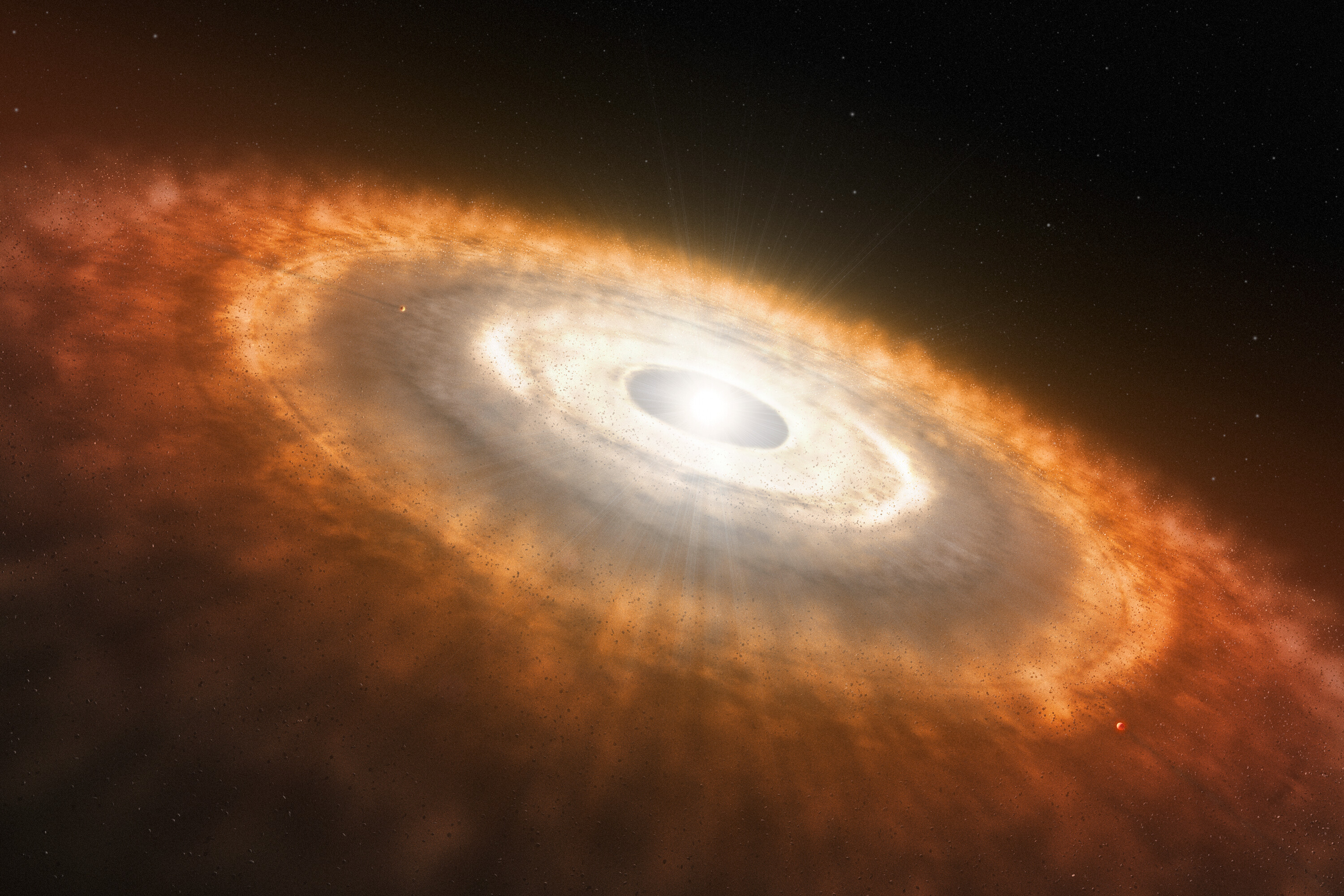
Figure:
Artist’s impression of a protoplanetary disc: a rotating disk of dust and gas surrounding a newborn star.
The material within gradually clumps together through collisions and gravity, forming planetesimals that eventually evolve into planets.
[ESO, 2023] Artist's impression of protoplanetary disc
ESO/L. Calçada (2023)
.
These planetesimals were scattered throughout the Solar System, potentially numbering in the billions.
With their orbits interweaving, collisions between them were extremely frequent. Every impact could make them larger.
When some planetesimals grew slightly bigger than their neighbours, their gravity also increased. This made it easier for them to attract nearby debris and small bodies.
This imbalance led to runaway growth: larger bodies gained mass more rapidly because their stronger gravity increased both collision rates and accretion efficiency.
As this uneven growth continued, some bodies eventually grew into planetary embryos hundreds of kilometres across [Thomas K. Henning et al., 2014] The multifaceted planetesimal formation process
Thomas K. Henning et al. (2014)
Protostars and Planets VI. University of Arizona Press
DOI: 10.2458/azu_uapress_9780816531240-ch024 [Kokubo et al., 2000] Formation of protoplanets from planetesimals
Kokubo, E., Ida, S. (2000)
Bioastronomy 99
.
At this point, their gravity was strong enough to accrete surrounding material far more efficiently, accelerating their own evolution.
Today, in the main asteroid belt between Jupiter and Mars, we can still see the remnants of these planetesimals, fragments that failed to merge into a planet during the Solar System’s formation. Without Jupiter’s gravitational disturbances, the asteroid belt might have assembled into a full planet. Bodies like Ceres and Vesta are, in essence, unfinished planetary embryos. This incomplete formation highlights an important fact: planet formation is not guaranteed; it depends sensitively on the gravitational environment. Earth was once one of them. But Earth did not stop at that stage. It continued to accrete, colliding and merging, steadily clearing the debris from its orbit, until it became the sole dominant body in its path.
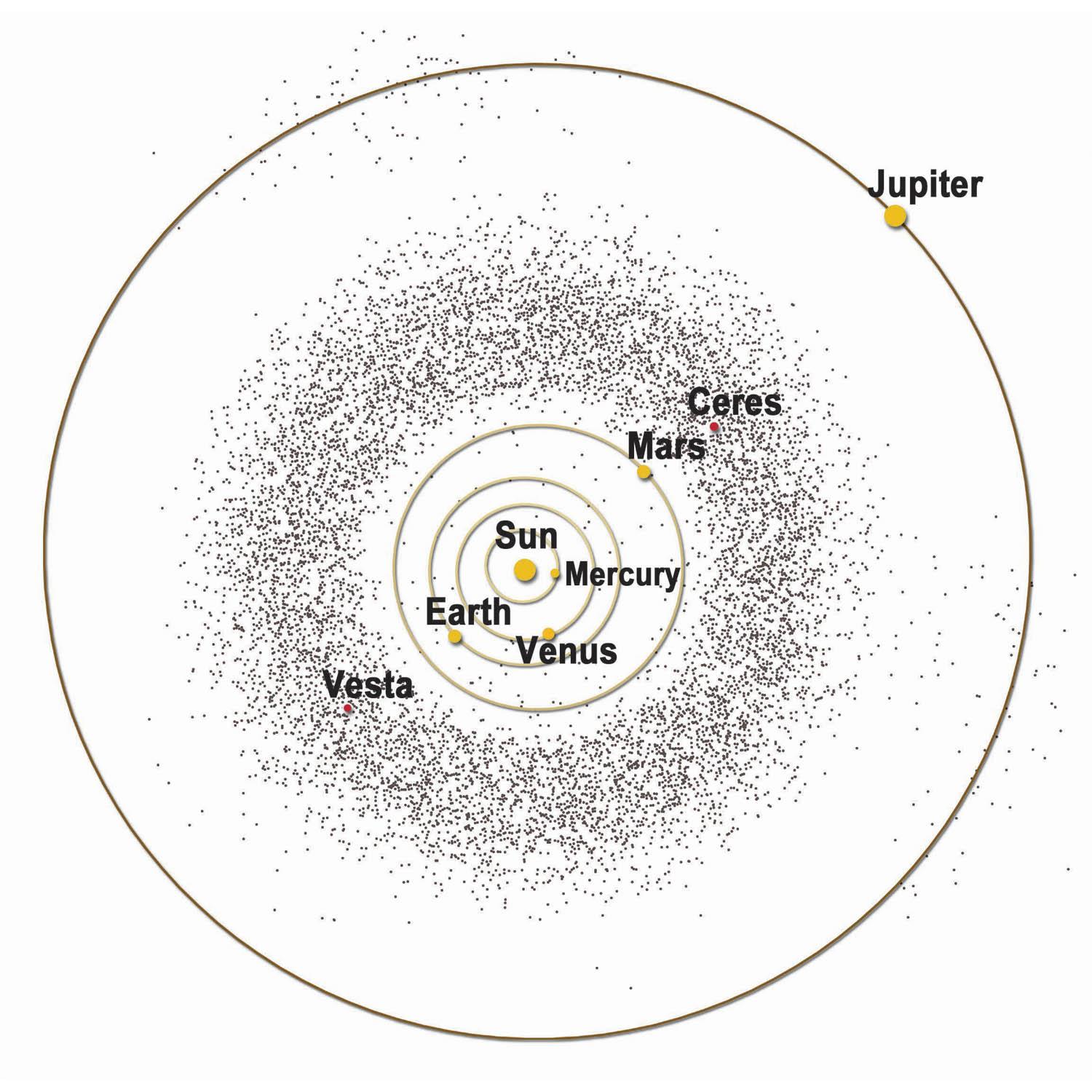
Figure:
The main asteroid belt, located between Jupiter and Mars, contains a large population of planetesimal remnants, fragments that never successfully merged into a planet.
Their existence is evidence that planet formation in the early Solar System was a process full of competition and collision.
[NASA, 2007] Asteroid Belt
NASA/McREL (2007)
.
Heat from the Inside Out
Accretion was not simply a matter of collision and merger. It was accompanied by an enormous release of energy. The planetesimals that collided with each other carried significant kinetic energy due to their orbital motion around the Sun. During these collisions, that kinetic energy was converted into heat, causing local temperatures to spike dramatically.
This can be described by a simple physical relationship:
where is kinetic energy, is the mass of the object, and is its velocity. Kinetic energy depends on both mass and speed. In the early Solar System, these bodies often moved at several kilometres per second. When they collided, the enormous kinetic energy could not disappear; it converted into heat, causing local temperatures to spike rapidly.
More importantly, these collisions happened continuously.
During that period, planetesimals were numerous and their orbits crossed constantly, making collisions extremely frequent.
Before the heat from one impact had time to dissipate, the next impact had already occurred.
Heat accumulated relentlessly, driving the planet’s temperature ever higher, ultimately reaching thousands of kelvins, enough to melt rock. [Chambers, 2004] Planetary accretion in the inner Solar System
Chambers, J. E. (2004)
Earth and Planetary Science Letters
DOI: 10.1016/j.epsl.2004.04.031 .
Two additional processes also continuously supplied heat to the young Earth. The first was radioactive decay. The early Earth contained large quantities of unstable radioactive elements, such as aluminium-26 and iron-60. These came from the interstellar material present when the Solar System formed, and were incorporated into Earth as it accreted. These elements decayed naturally, releasing high-energy particles and heat. Over time they gradually depleted, but in Earth’s early stages they were an important source of warmth. These short-lived isotopes provided an intense but temporary heat source during the earliest stages of planetary formation.
The second, equally important but less visible, heat source was gravity itself. As Earth grew larger, material continuously sank toward its centre. In this process, the gravitational potential energy of the infalling material decreased, and that energy did not vanish; it was converted into heat. For a roughly spherical body of uniform density, this can be approximated as:
where is the gravitational potential energy, is the gravitational constant, is the planet’s mass, and is its radius. As material sank inward, decreased and the magnitude of grew, meaning more energy was released, causing local temperatures to spike dramatically.
Together, these three mechanisms (impacts, radioactive decay, and the conversion of gravitational potential energy) kept the young Earth at extreme temperatures from its interior to its surface. Under these conditions, Earth’s material did not exist in solid form. Instead, it was molten, a necessary prerequisite for everything that followed.
Planetary Differentiation: The Layering of the Planet
Today’s Earth is a layered planet. From the core to the mantle to the crust, each layer has a distinct composition and character.
But in Earth’s earliest stages, this structure did not exist.
The young Earth was more like a scorching, chaotic ball of mixed material, delivered by countless colliding and merging fragments of space debris.
This chaotic body was not made of a single element; it was dominated by iron, oxygen, silicon, magnesium, and others [Allègre et al., 1995] The chemical composition of the Earth
Allègre, C. J., Poirier, J.-P., Humler, E., Hofmann, A. W. (1995)
Earth and Planetary Science Letters
DOI: 10.1016/0012-821X(95)00123-T .
These elements differ greatly in density, a fact that would prove decisive in Earth’s subsequent evolution.
| Element | Symbol | Mass fraction (%) | Density (g/cm³) |
|---|---|---|---|
| Iron | Fe | 32.1 | 7.87 |
| Oxygen | O | 30.1 | 1.43 × 10⁻³ |
| Silicon | Si | 15.1 | 2.33 |
| Magnesium | Mg | 13.9 | 1.74 |
| Sulphur | S | 2.9 | 2.07 |
| Nickel | Ni | 1.8 | 8.91 |
| Calcium | Ca | 1.5 | 1.55 |
| Aluminium | Al | 1.4 | 2.70 |
| Others | — | 1.2 | — |
When the entire planet was at high temperature (even in a molten state), material was no longer locked in place but could flow slowly. Under these conditions, gravity began to sort materials by density. Denser materials, such as iron and nickel, were “heavier” and gradually sank toward the planet’s interior under gravitational pull. Lighter materials, such as silicon- and oxygen-rich compounds, were relatively buoyant and rose toward the surface. This process did not happen instantaneously. It occurred continuously within the flowing magma. Inside the early Earth, this sorting may even have taken place in a striking, almost cinematic way: liquid metal descended in droplets, like a relentless “rain of iron,” gradually pooling at the planet’s centre. Over time, the sinking metal formed the core, while the lighter material above became the mantle and crust.
This process was not without interruption. Impacts remained frequent in the early Solar System. Each major collision could stir up the planet’s interior again, disrupting the layering and forcing it to restart. Only as impacts gradually decreased was Earth able to maintain a stable internal structure over extended periods. After billions of years of evolution, the result is the clearly defined, layered planet we inhabit today. This process is known as planetary differentiation.
Consequences of Layering
Layering was not simply a reshuffling of element positions; it was accompanied by a tremendous release of energy. As heavier materials sank toward Earth’s centre, their gravitational potential energy continuously decreased, and that energy was converted into heat, further warming the planet’s interior. This allowed Earth to remain at high temperatures even after the era of heavy bombardment.
In the core, temperatures can reach thousands of degrees Celsius. Under these conditions, iron remains molten, forming a core of electrically conductive liquid. Driven by Earth’s rotation and internal thermal convection, this flowing conductive material generates electric currents, which in turn produce a magnetic field. Initially, this field may have been relatively weak. But as Earth’s interior gradually stabilized, the process continued, ultimately producing a planetary magnetic field extending far into space, one of Earth’s most important protective layers.
A World Begins to Take Shape
From drifting fragments in space to a layered world of rock, metal, heat, and motion, Earth had already taken its basic form. Gravitation gathered it, impacts heated it, and differentiation reshaped it from within. What once lay scattered as debris had become a young, active planet. But this was still only the beginning. Earth was not yet calm, not yet solid, and not yet the world we know today.
References
- [2015] (2015). The Neolithic Revolution. Encyclopædia Britannica
Link - [Dalrymple, 2001] Dalrymple, G. B.(2001). The age of the Earth in the twentieth century. Geological Society of London Special Publications
DOI: 10.1144/GSL.SP.2001.190.01.14 - [Williams et al., 2011] Williams, J. P., Cieza, L. A.(2011). Protoplanetary disks and their evolution. Annual Review of Astronomy and Astrophysics
DOI: 10.1146/annurev-astro-081710-102548 - [Blum et al., 2008] Blum, J., Wurm, G.(2008). The growth mechanisms of macroscopic bodies in protoplanetary disks. Annual Review of Astronomy and Astrophysics
DOI: 10.1146/annurev.astro.46.060407.145152 - [ESO, 2023] ESO/L. Calçada(2023). Artist's impression of protoplanetary disc
Link - [Thomas K. Henning et al., 2014] Thomas K. Henning et al.(2014). The multifaceted planetesimal formation process. Protostars and Planets VI. University of Arizona Press
DOI: 10.2458/azu_uapress_9780816531240-ch024 - [Kokubo et al., 2000] Kokubo, E., Ida, S.(2000). Formation of protoplanets from planetesimals. Bioastronomy 99
Link - [NASA, 2007] NASA/McREL(2007). Asteroid Belt
Link - [Chambers, 2004] Chambers, J. E.(2004). Planetary accretion in the inner Solar System. Earth and Planetary Science Letters
DOI: 10.1016/j.epsl.2004.04.031 - [Allègre et al., 1995] Allègre, C. J., Poirier, J.-P., Humler, E., Hofmann, A. W.(1995). The chemical composition of the Earth. Earth and Planetary Science Letters
DOI: 10.1016/0012-821X(95)00123-T
Responses are welcome. Please keep comments thoughtful and relevant.