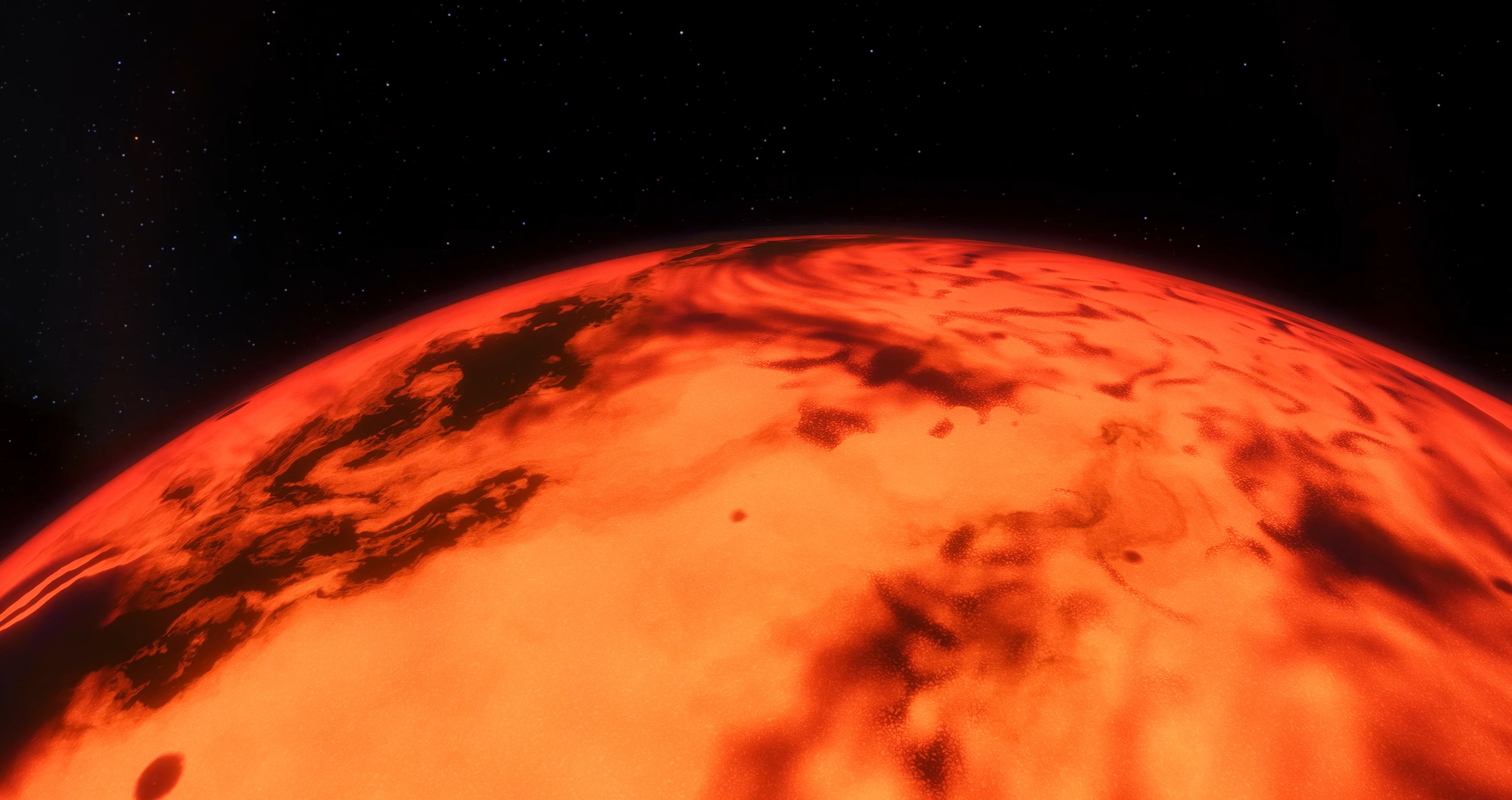
By 4 Billion Years Ago, Earth Had Finally Stopped Being Repeatedly "Reset"
This post explores the first major turning point in Earth’s history: the transition from a world that was constantly being reset into a planet capable of preserving its own history.
This was the transition from the Hadean Eon to the Archean Eon.
The Hadean, an Age of Amnesia
Earth formed about 4.54 billion years ago, and its first 600 million years are known as the Hadean Eon. During that time, Earth left behind almost no memory of itself. Rocks formed, but could not endure. Water may have appeared for a time, but soon vanished. Everything that had just happened was erased almost immediately.
That is why our understanding of this period remains extremely limited today. It is not because nothing happened, but because almost nothing was preserved. The Earth of that time was more like a world that kept losing its memory. Every new “memory” disappeared before it had time to become part of the past.
Why Did Earth Go Through This “Amnesia”?
In the early Solar System, space was filled with leftover material that had not yet been cleared away, including dust, rock, and ice. Under the pull of gravity, these materials kept colliding and clumping together, gradually forming planets and moons. The Earth we know today is what remained after it swept up nearly all the matter along its orbital path.
So in the early Hadean, Earth’s orbit was not yet “clean”. Large amounts of debris continued to cross that orbit and collide with the growing planet. Some of that material was eventually added to Earth, but every merger came with violent impacts and huge releases of energy.
That energy kept raising Earth’s temperature and maintained intense heat in its surface and shallow interior. Newly formed crust would melt again, existing structures would be shattered, and the surface environment could never remain stable for long.
Impact rates were extremely high in the early Hadean, on average with one event every million years large enough to reset the surface. Between impacts, Earth did move toward cooling and stability. But those brief quiet intervals never lasted long enough for the changes to be truly preserved. The result was not that Earth failed to form stable structures, but that it was repeatedly driven back to the beginning.
Among all these impacts, the most famous was the Theia impact. That event not only reshaped Earth’s surface, it also formed Earth’s only natural satellite, the Moon. Impacts like this released enough energy to vaporise rock and seawater, making it difficult for any geological record that had already formed to survive. Rocks, minerals, and even possible traces of early life were continually buried over and rewritten in such an environment.
From Amnesia to Memory, Earth’s Turning Point
Although impact rates were extremely high in the early Hadean, they did not stay at that level forever. Around 600 million years after Earth’s birth, or about 3.9 billion years ago, a change began to emerge. As debris along Earth’s orbit was gradually cleared away, the frequency of impacts started to decline. This was a change in the planet’s rhythm of growth. Earth had passed through its most violent phase. Destruction was no longer quite so frequent.
As time went on, the debris in Earth’s orbit continued to thin out. Impacts still happened, but the intervals between them began to lengthen. For the first time, that gave the surface a new possibility: it could exist for a little longer before the next catastrophe arrived.
At the same time, Earth itself continued to cool. New impacts no longer always carried enough energy to reset everything completely. Some resilient fragments of crust began to survive these collisions. They became the oldest surviving memories of Earth, the parts of its history that were never entirely erased.
The First Survival of the Crust
Among the memories that began to survive, the earliest preserved crust can be traced back to about 3.9 billion years ago. This may not have been the first crust Earth ever formed, but it was the first crust that truly survived. As the outer layers kept cooling, the colder and more rigid lithosphere gradually thickened. Even so, it was still discontinuous and far from stable. At that stage, the crust was more like a thin sheet of ice stretched over a churning, high-temperature mantle. But once that outer shell became just a little thicker, the crust that had already formed was no longer so easily swallowed again or completely remelted. A subtle but decisive change followed: crust began to shift from a short-lived product into an entity capable of inheriting history.
At the same time, chemical differentiation was quietly reshaping this process. Partial melting gradually concentrated lighter material in the upper layers, producing crust with greater buoyancy. And the lighter the crust became, the more easily it could remain at the surface. So a self-reinforcing process began to appear: the more easily crust could survive, the more chance it had to continue evolving; the more evolved the crust became, the more likely it was to survive.
The zircons discovered in the Jack Hills of Western Australia provide tiny but crucial evidence for this stage. These crystals, about 4.4 billion years old, record signs that their parent rocks had interacted with liquid water. They do not mean that broad, stable continents already existed at the time, but they do show that some fragments of crust were already capable of crossing deep time and being preserved. From that moment on, Earth’s surface acquired continuity for the first time.
Why Can Only Solid Crust Preserve Memory?
In the earlier Hadean, rocks did solidify from time to time. Crust may have formed many times, and some regions may even have cooled briefly. The problem was that they melted again during later impacts or renewed internal heating.
As long as later impacts or internal thermal activity were strong enough to melt those rocks again, all the information they once carried would be erased.
When rock enters a fully molten state, crystal structures are destroyed, the relationships among minerals are broken apart, and many isotope systems are redistributed as well. When new rock later cools and forms again, it records only the conditions of that latest solidification, not the earlier history that once existed. In other words, the Earth of the Hadean was not without records, its records were simply being rewritten again and again.
At some point, however, that cycle began to change. Some fragments of crust no longer underwent complete remelting. They were altered, but not completely erased. Fracturing, metamorphism, and local melting began to replace total reset. Older structures could remain, while newly formed material accumulated on top of them. Time was no longer being reset to zero, it was starting to accumulate. From that moment on, Earth’s surface truly changed from a repeatedly reset system into a system capable of preserving memory.
Water Begins to Leave Traces
Once water could remain on the surface for extended periods, it was no longer just a layer of liquid spread across the planet, it began to change the way Earth itself evolved. Water entered rocks and drove chemical reactions. Water circulated through fractures and carried heat away. Water flowed across the surface, transporting and depositing material. Processes that had once been relatively separate began to connect with one another.
Hydrothermal circulation was especially important. Seawater seeped down through fractures into hot regions, then rose again after being heated, forming a sustained convective system. This not only accelerated the cooling of the crust, it also turned the surface into a place of constant exchange and reorganisation of matter. Minerals were altered, elements were transported, and structures were reorganised.
A new relationship began to emerge: rock, atmosphere, and water were no longer independent of one another, but became linked, interactive, and mutually transformative. Earth’s surface was no longer merely enduring change, it was beginning to form a system that could keep operating through time. From that moment on, change no longer simply happened, it began to interact with other changes and leave more complex traces behind.
The World’s First Memory
Around 4.0 billion years ago, geological time entered the Archean Eon. Volcanoes were still active, the mantle was still intensely hot, and impacts had not disappeared completely. Earth had not become peaceful. But something deeper had already begun to change. It had started to preserve its own transformations. The older pattern of frequent resets that reduced everything to zero was becoming secondary. In its place came modification, accumulation, and inheritance.
The crust could still be reshaped, but it was no longer always completely erased. Water could still be disturbed, but it no longer vanished so easily. Change no longer merely took place. It began to leave traces, and those traces began to accumulate on one another. From that moment on, Earth was no longer just a planet being shaped. It was beginning to become a world capable of remembering its own history. It had begun to remember itself.
Responses are welcome. Please keep comments thoughtful and relevant.